Primary Maths & English Tutoring
No strong foundation is built from a single material, brick needs mortar, Maths needs English.
Yet the two are almost always taught as opposing directions, and in doing so the most important connections in a child’s education are missed entirely. The logical thinking developed through Maths is the thinking that allows students to make strong conclusions when reading and write well structured responses. The comprehension skills of English allow students to correctly interpret challenging maths concepts.
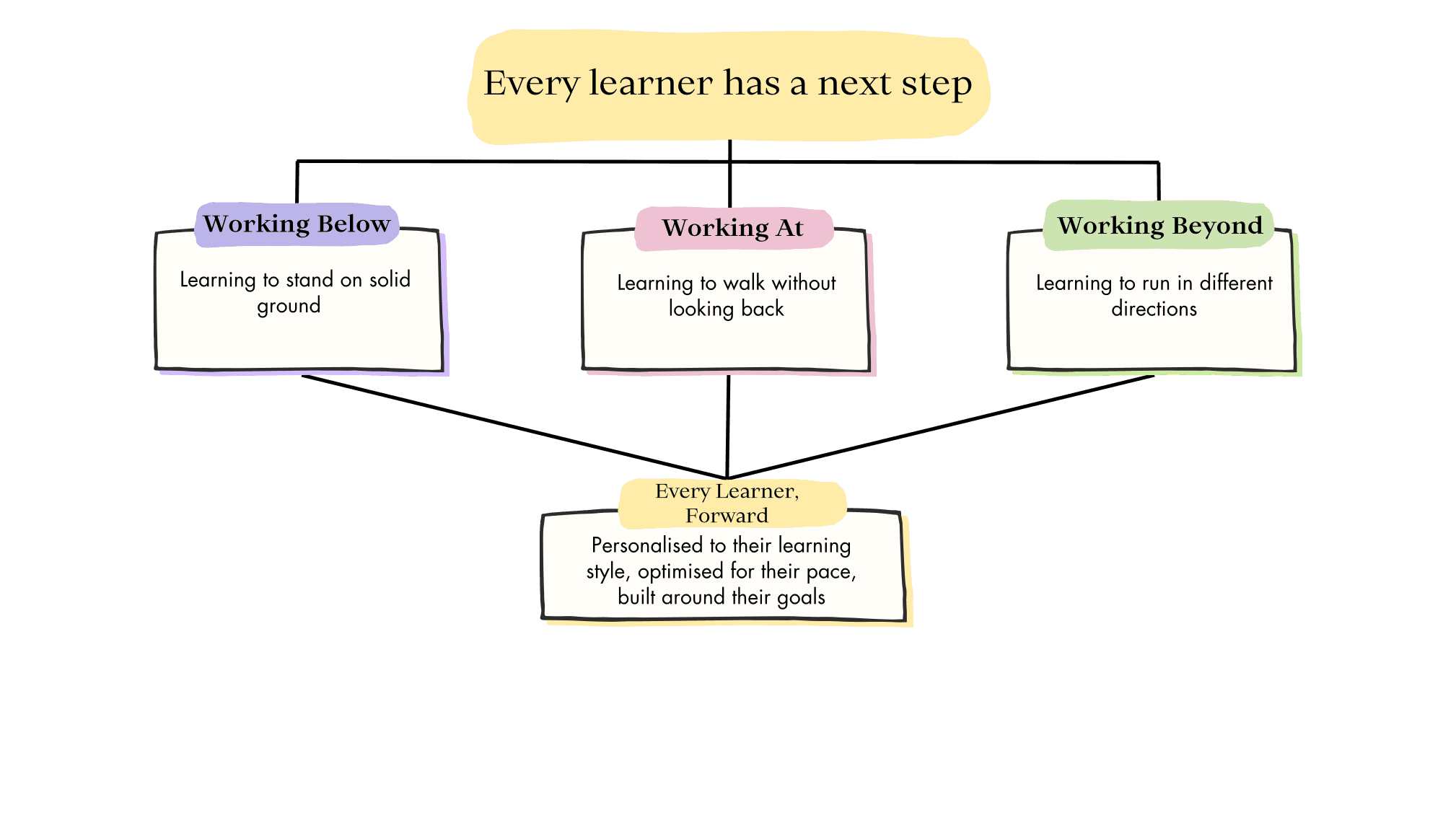
At Cornerstone, both are developed simultaneously. We track precisely what a student has mastered and where they are stuck, then build their practice around the gaps: moving faster when they are ready, slower when they need it.
Our understanding of the curriculum, and of how each strand functions across subjects, is what shapes this: a deliberate synthesis of multisensory, lateral application and sequential learning.
Our approach makes learning as efficient and clear as possible.
What does a session actually look like?
There is no fixed structure. Each lesson is built entirely around your child's individual needs. That can mean dividing time differently per subject or even per individual topic week by week. What we do guarantee is each session is customised and optimised for each child.
How do I know what my child is working on and how they're progressing?
After every session, parents receive a personalised student report covering what was worked on, and where their child sits relative to the NSW curriculum. Frequent, low-stress assessments are conducted based on homework completion to ensure concepts are landing.
How flexible is the program?
Completely. Unattended hours are never charged, and students can attend multiple sessions per week based on parent preference and student need. Every session builds on the individual child's level and ability.
We have more than one child. Can they attend together?
Cornerstone was built by a mother and her three sons, so sibling learning is something we understand deeply. We actively encourage siblings to attend together. Learning alongside each other develops more than academic skills: it builds accountability, responsibility, and a shared drive to improve that accelerates the progress of both.
Primary Maths & English Tutoring
No strong foundation is built from a single material, brick needs mortar, Maths needs English.
Yet the two are almost always taught as opposing directions, and in doing so the most important connections in a child’s education are missed entirely. The logical thinking developed through Maths is the thinking that allows students to make strong conclusions when reading and write well structured responses. The comprehension skills of English allow students to correctly interpret challenging maths concepts.
At Cornerstone, both are developed simultaneously. We track precisely what a student has mastered and where they are stuck, then build their practice around the gaps: moving faster when they are ready, slower when they need it.
Our understanding of the curriculum, and of how each strand functions across subjects, is what shapes this: a deliberate synthesis of multisensory, lateral application and sequential learning.
Our approach makes learning as efficient and clear as possible.
What does a session actually look like?
There is no fixed structure. Each lesson is built entirely around your child's individual needs. That can mean dividing time differently per subject or even per individual topic week by week. What we do guarantee is each session is customised and optimised for each child.
How do I know what my child is working on and how they're progressing?
After every session, parents receive a personalised student report covering what was worked on, and where their child sits relative to the NSW curriculum. Frequent, low-stress assessments are conducted based on homework completion to ensure concepts are landing.
How flexible is the program?
Completely. Unattended hours are never charged, and students can attend multiple sessions per week based on parent preference and student need. Every session builds on the individual child's level and ability.
We have more than one child. Can they attend together?
Cornerstone was built by a mother and her three sons, so sibling learning is something we understand deeply. We actively encourage siblings to attend together. Learning alongside each other develops more than academic skills: it builds accountability, responsibility, and a shared drive to improve that accelerates the progress of both.
Primary Maths & English Tutoring
No strong foundation is built from a single material, brick needs mortar, Maths needs English.
Yet the two are almost always taught as opposing directions, and in doing so the most important connections in a child’s education are missed entirely. The logical thinking developed through Maths is the thinking that allows students to make strong conclusions when reading and write well structured responses. The comprehension skills of English allow students to correctly interpret challenging maths concepts.
At Cornerstone, both are developed simultaneously. We track precisely what a student has mastered and where they are stuck, then build their practice around the gaps: moving faster when they are ready, slower when they need it.
Our understanding of the curriculum, and of how each strand functions across subjects, is what shapes this: a deliberate synthesis of multisensory, lateral application and sequential learning.
Our approach makes learning as efficient and clear as possible.
What does a session actually look like?
There is no fixed structure. Each lesson is built entirely around your child's individual needs. That can mean dividing time differently per subject or even per individual topic week by week. What we do guarantee is each session is customised and optimised for each child.
How do I know what my child is working on and how they're progressing?
After every session, parents receive a personalised student report covering what was worked on, and where their child sits relative to the NSW curriculum. Frequent, low-stress assessments are conducted based on homework completion to ensure concepts are landing.
How flexible is the program?
Completely. Unattended hours are never charged, and students can attend multiple sessions per week based on parent preference and student need. Every session builds on the individual child's level and ability.
We have more than one child. Can they attend together?
Cornerstone was built by a mother and her three sons, so sibling learning is something we understand deeply. We actively encourage siblings to attend together. Learning alongside each other develops more than academic skills: it builds accountability, responsibility, and a shared drive to improve that accelerates the progress of both.
Primary Maths & English Tutoring
No strong foundation is built from a single material, brick needs mortar, Maths needs English.
Yet the two are almost always taught as opposing directions, and in doing so the most important connections in a child’s education are missed entirely. The logical thinking developed through Maths is the thinking that allows students to make strong conclusions when reading and write well structured responses. The comprehension skills of English allow students to correctly interpret challenging maths concepts.
At Cornerstone, both are developed simultaneously. We track precisely what a student has mastered and where they are stuck, then build their practice around the gaps: moving faster when they are ready, slower when they need it.
Our understanding of the curriculum, and of how each strand functions across subjects, is what shapes this: a deliberate synthesis of multisensory, lateral application and sequential learning.
Our approach makes learning as efficient and clear as possible.
What does a session actually look like?
There is no fixed structure. Each lesson is built entirely around your child's individual needs. That can mean dividing time differently per subject or even per individual topic week by week. What we do guarantee is each session is customised and optimised for each child.
How do I know what my child is working on and how they're progressing?
After every session, parents receive a personalised student report covering what was worked on, and where their child sits relative to the NSW curriculum. Frequent, low-stress assessments are conducted based on homework completion to ensure concepts are landing.
How flexible is the program?
Completely. Unattended hours are never charged, and students can attend multiple sessions per week based on parent preference and student need. Every session builds on the individual child's level and ability.
We have more than one child. Can they attend together?
Cornerstone was built by a mother and her three sons, so sibling learning is something we understand deeply. We actively encourage siblings to attend together. Learning alongside each other develops more than academic skills: it builds accountability, responsibility, and a shared drive to improve that accelerates the progress of both.